David Fincher- A hugely world known director of many mediums. He is probably best known for his words in products such as 'Seven', 'Gone Girl' and 'Fight Club', again all widely known films. Madonna, George Michael, Michael Jackson and Justin Timberlake.
Spike Jonze- His breakthrough video for the Beastie Boys song "Sabotage" won four MTV Video Music Awards, and he went on to direct several music videos and commercials throughout the 1990s.
Lady Gaga, Kanye West, Jay- Z, The Notorious B.I.G and Fatboy Slim are just some of the huge artists that Jonze has worked with.
Jonze has directed several popular music videos and films, earning an Academy Award nomination for 'Being John Malkovich' and an Oscar win for 'Her.
As well as the greats, I have then also further researched into who I would consider my favourite Music Video Directors.
Mark Romanek- Romanek was given his first Grammy for his short video for 'Scream', performed by Michael Jackson and his sister Janet. Their collaboration was so iconic, and is now referred to as the most expensive video ever made, seeing as it cost $7 million! Another brilliant video Romanek had made was Taylor Swifts 'Shake It Off', which is personally one of my favourite videos. I love how she has represented all versions of dance, and even tried to attempt them herself! Other honourable video mentions are Jay-Z's '99 Problems' and Coldplay's 'Speed of Sound'.
Director X- This man is probably my most favourite director of all time! He should be known by everyone, as somehow he has managed to work with the majority of the biggest artists in the 21st Century. From the likes of Usher, Kanye and R.Kelly to the really up to date Drake, Rhianna, Bieber and Nicki Minaj, it is clear that there is not really an artist that Director X hasn't worked with!
Whether it be in film, or in music, Media uses a term entitles 'The Male Gaze', which occurs when the audiences are put into the perspective of a heterosexual man. For instance, this may be apparent when a camera is focused on a woman's assets, such as her curves. However, it is actually only 'considered' if the certain aspects are highlighted with slow motion movements, or deliberate cut aways. The theory also suggests that woman audiences can only view from a second person perspective, obviously behind the 'males'.
A musical interpretation of The Male Gaze would be seen in the Fratellis album covered, which is pictured above. Notice how there are no signs of male activity, and the women pictured are all slender, have long legs, are heavily made up and have extremely short dresses that show their stockings. By the band choosing to use this picture as an album cover it would immediately grab all genders attention. The women are all seen to have curves, and have very low-cut dresses on, stressing their seductive nature further. A highly controversial but effective album cover.
The Male Gaze is very common in James Bond, in particular the opening credits. I am going to use 'Spectre' screenshots to explore this in more detail.
Within the shot above, it is clear that there is a woman pictured with a twisted octopus's tentacle to cover up her body slightly. If the link below is clicked, audiences will see that this entire opening credits scene is in slow motion, which conforms and echoes Laura Mulvey's theory even further.
'Music Video's ignore common narrative as they are essentially advertisements. As consumers, we make up our own meaning of a song in our minds: a Music Video can anchor meaning and gives the record company/ artist a method of anchoring meaning'.
Andrew Goodwin came up with five key concepts that he believes audiences should notice and look out for when watching Music Video's.
-Thought Beats First step according to Goodwin was for audiences to look at the music itself. He wanted audiences to take into account a song's structure (verses and chorus). The second step would be the 'voice of the song'. The artist his/herself is an instruments and therefore is able to be unique. Roland Barthes theory of the 'grain of voice' also links to this. The third is where Goodwin indicates to audiences that the artist is some sort of 'storyteller', and us (the listeners) are listening. The video is a communication device, a visual representation of the story.
-Narrative and Performance As listeners, Goodwin argues that we only ever tend to get the general idea around a song, and we end up making up the rest of the interpretation ourselves.
Narrative and Performance go hand in hand, and make it incredibly easy for audiences to watch a music video over and over again, without loosing interest. By artists acting as both a narrator and then also a participant helps aid the authenticity. Despite this, the lip sync and other mimed actions remain the centre of a music video. Audiences need to witness relatable performances.
-The Star Image
Meta narrative (a story that describes the development of the star over time) has serious importance in the videos production. Artists want to look unique in order to stay within trend, and to have a lasting effect on it's audiences. The star image develops overtime, allowing the artists to stay current and remembered for the right reasons.
-Relation of Visuals Illustrate: Video's can use a sequence of images to convey meanings. Amplify: Meanings and effects are constantly apparent in the video, in order to be drummed into the audiences vision. Disjuncture: This is when the meaning of the song is completely ignored. -Technical aspects These hold the video together, through all of the conventions I have already explored on my previous post. Speed, camera movement, editing and overall production are all uses of camera. Lighting and colour helps to aid the video's mood, and is used for emphasis. Mise En Scene is used for dramatic and authentic use mostly. Beats. Video's use cuts in order to co-inside with the songs beat breaks.
Unsurprisingly, this is the type of video where the artist or band is seen to be performing either to a staged audience, or even just to the camera. This is typically seen to be a popular method for the 'Rock' artists to use within their video's.
However, this stereotype is challenged, as other artist such as Outcast with 'Hey Ya', or even in 1980 and Kool and the Gang with 'Celebration'.
This video is possibly one of my personal favourites, as it consists of 'Andre 3000' performing in his 'band' to a screaming crowd of predominantly ladies. However, if audiences look closely enough, they will see that in fact ALL 'band' members are in fact the same person. From a technical standpoint, this has always been a very simple but clever concept, and has proven to be highly effective and gripping. Narrative: Narrative video's are where there is a story playing on top of the music itself. Within this video genre, there are actually three sub- narrative video options. Illustration- This is where the narrative in the music video exceedingly fits with the lyrical content of the song. This could be better explained with Taylor Swift's 'Love Story' music video.
Amplification- This is where the narrative may be slightly influenced by the lyrical content, however it uses different themes to compliment the songs 'feelings'. To make it easier, it may be simpler to watch Coldplay's 'Paradise' music video, as this uses amplification.
Disjunction- Finally, this is where the narrative holds very little common ground with the actual song, and is seen to have a quite a random meaning to it. One music video that particularly sticks out for me is Gotya's 'Somebody that I used to know'.
Concept:
These types of music video's usually have no storyline and have little to no relationship with the song's lyrical concept either. These video's usually have no plot line, and is seen to be entirely interpretive with the audiences deception. A solid example to express this idea further could be Drake' 'Take Care' video (https://www.youtube.com/watch?v=-zzP29emgpg ).
It was extremely hard to research what Music Video's are the favourites within the industry, as nowadays there is so much variety, in artist and therefore in their video's. Seeing as the Music World is such a large, dynamic market, it is impossible to pin-point the very best, so instead I have picked out a couple of video's that are (in my eyes) genius.
Throughout Beyonce's career, She was apart of a band called 'Destiny's Child'; the band saw sales of over 60 million. The singer has then managed to sell over 100 million records from going solo.
Her most iconic video for 'Single Ladies' had sales of 6.1, and became 'one of the best-selling singles of all time'. For this video in particular, Beyonce wanted a relatively simple video to accompany this song. As it can be seen when watched, it seems to encompass minimal variations of camera work and transitions, along with no changes in make-up or costumes. The star wanted the video to give off a 'feel good' atmosphere, and to include choreography that could be attempted by anyone!
A critic once regarded and described 'Thriller' as "the groove of its bassline, paired with Michael's killer vocals and sleek moves" as having "produced a frighteningly great single". MJ's 'Thriller' is one of the most iconic and referred to music video's of all time. It has received 414 million views on YouTube, making it an internet sensation. The singer admitted to paying for the production of his 'film' all on his own, coming to a grand total of 1 million US Dollars. This 'King of Pop' is now considered a legend of the industry, yet his music still lives on!
3. 'Toxic'- Britney Spears ( https://www.youtube.com/watch?v=LOZuxwVk7TU ) Some called it "irresistible ear candy' andpowerfully addicting', some said 'In the name of fairness, it will be noted that 'Toxic' and 'Showdown' could well have been good pop songs in the hands of any other singer than Spears'. Although not considered the best singer of all time, Spears' 'Toxic' video was ground-braking! Her director Khan explained the star's hallway dance of imaginary lasers in front of a green screen was absolutely 'incredible to watch'. The cost of such a show cost the star 1 million US Dollars to make. When viewers view her video, they would spot that every single scene pictures is completely different, and all have differing structured routines.
Next up is the "unrepentantly romantic", the timeless 'Yellow'. One critic even demonstrated that "every time that electric-guitar riff barges in, you're hooked all over again."
The video is one continuous shot with no cuts or editing elements involved. The entire thing is seen to be in slow motion. The video is minimalistic, featuring only lead vocalist Chris Martin singing the track as he walks along a beach in Southern Dorset. He is seen wearing a set of waterproofs with his hair wet, suggesting that it had just rained. A simplistic, but highly affective music video.
5. 'Vogue'- Madonna ( https://www.youtube.com/watch?v=GuJQSAiODqI ) 'Vogue'. One of my personal favourite music video's. The timeless black-and-white theme that runs throughout is truly beautiful, and represents the look of class, and could be seen to be influenced by 'The Golden Age' movies in Hollywood. Many of Madonna's scenes within the video are recreations of photographs by the remarkable Horst P. Horst. One of these examples includes his 'Mainbocher Corset'. However, the photographer was seen to be extremely 'displeased' with the stars video, as he was never asked permission for the 'Queen of Pop' to use his pieces as an influence. Some of her most famous close up shots are recreations of pictures from icons such as Marilyn Monroe.
Camera movements and shots in particular are usually seen to be extremely frequent and of high intensities, in order to keep audiences intrigued and enraptured with the visual aspect of a particular song.
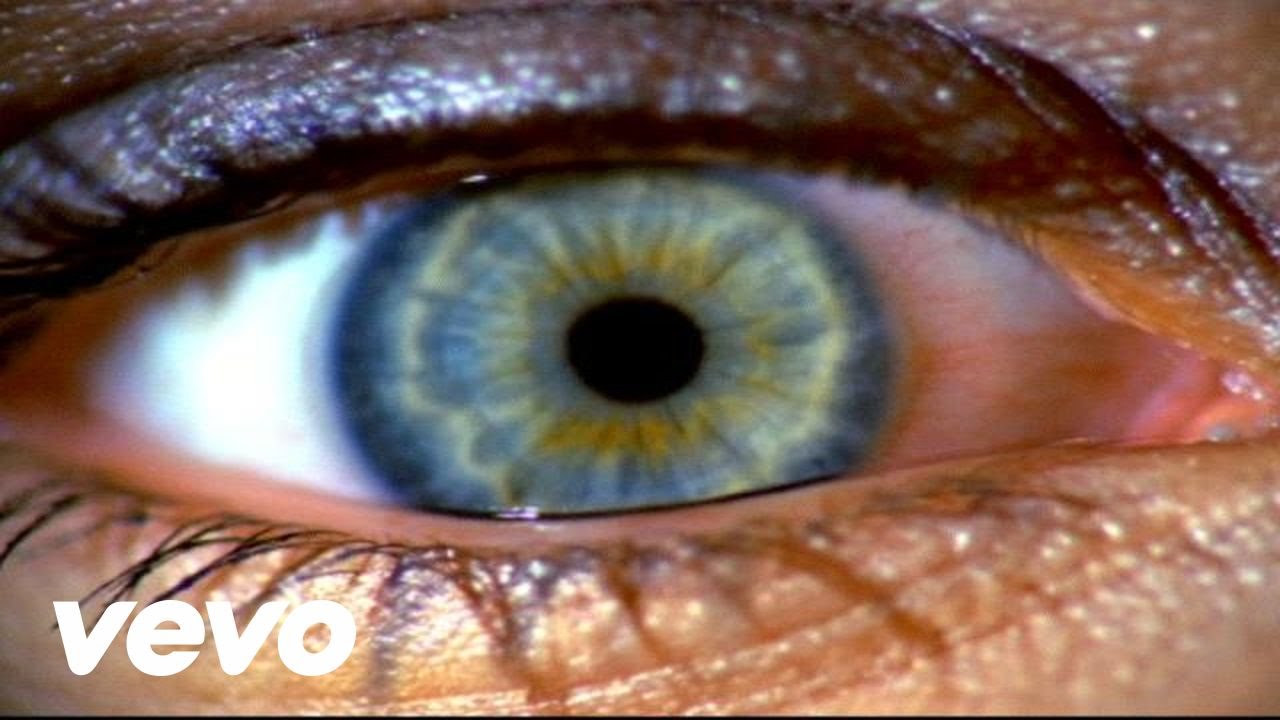
As expected, the shots used in a music video will be varied, depending on the setting and atmosphere that directors and artists wish to convey. It is fair to say that 'Extreme Close Ups' are a popular shot to use, as this expresses emotion (in some cases), and grabs the audiences attention. An example of this is seen in Moby's 'Porcelain', where the whole video is based around an extreme close up of an eye.
In terms of camera angles, it is fair to say that all artists and bands are always seen to vary their camerawork in order to give their video a USP, or even a stand out platform, in order to get it noticed compared to their competition. The industry is one of the most competitive industries to try and grasp a foothold in, or even try to get into.
A low angled shot is widely seen across many music video's, as it allows the artist (or whoever is in shot) to be deemed as dominant and powerful. This can be seen in Kendrick Lamar's 'Humble' video, as seen below.
This point can also be vouched with Stormzy's 'ShutUp',
or even Tom Zanetti's 'You Want Me'
Editing:
In terms of transitions, in order to keep audiences entertained, it is clear that all music video editors are instructed to use a vide range of camerawork, and add fast changing and interesting transitions between each clip in order to continue to grasp audience attention. Obviously, this depends on the artist, and also the song. Interesting video's such as Coldplay's 'Yellow' are taken in one shot, and is focusing on how the sky changes colour, representing how time goes on. This is also seen by other artists such as James Blunt's 'Beautiful, where a similar idea is presented here also( https://www.youtube.com/watch?v=oofSnsGkops).
Bruno Mars is known for his brilliant accompanying music video's, but it is his most recent video that has personally struck me the most.
The singers video for 'That's What I Like' is my favourite video of his, as (like Chris Martin with Coldplay), it is clear that the video has been shot in one, but it is his editing that is of particular interest. Depending on the lyric, is the cartoon image equivalent around the singers movements, which I find very unique and clever. For example, when the line 'Jump in the Cadillac, girl, let's put some miles on it', a wheel and four car wheels appear around the singer.
Mise En Scene:
There are many aspects to Mise En Scene, and all of them are extremely important to artists when making a successful music video: Setting, Lighting, Costume and Make- Up, Positioning and Facial Expressions.
Setting:
Whether it be a typical party, or even footage of a picturesque beach, setting is an extremely interesting asset to a music video, as it is the setting (usually) that opens the entire video, as it sets the scene, or mood for the video.
An example of this is with the song 'Put Your Records On' by Corinne Bailey Rae. The setting sits extremely well with this opening scene of trees and wildlife, as her opening words of her song are 'Three little birds', meaning her setting fits perfectly with her nature theme.
Lighting: Similar to 'Setting', the Lighting really depends on an artist and what they are trying to convey in their video. Take a classic example such as Michael Jackson's 'Thriller'. There is deliberate dark lighting, and it is set in a night scene to reiterate the Thrill he is trying to express to his audiences.
A Light comparison to make would be Wilkinson's 'Afterglow', where it is seen that the subject is pictured to be up against a very light, white wall, empathising her natural beauty, her innocence and purity.
Costume and Make-Up:
Gaga is who immediately springs to mind when 'Costume and Make-Up' are mentioned. The 'Modern Madonna' is an absolute style icon, and has experimented with some ground breaking and extravagant outfits throughout her career so far.
Gaga uses a range of costumes and make up inspirations to get across her message to her 'Little Monsters' that they should dare to be different and to not be afraid to show the world who they really are.
A true inspiration to all!
Gaga (in her earlier career) wore heavy sets of make-up: dark eyeliner, bold lip shades, and think and dark eyebrows. However it would appear that in her recent video's, her extravagant nature has seemed to dim down slightly, and her recent track 'G.U.Y' shows a very bare Gaga, one with limited make-up.
Positioning and Facial Expressions:
When talking about Positions and Facial Expression, Miley Cyrus is really good current artist to use as my examples. It simply does not matter what genre of song she sings, she will always pull and create many facial expressions to suit her roles perfectly in her video's.
In this first moving image, the singer appears to be broadcasting a rebellious nature, with the song entitled '23'. With Miley having her tongue and mouth open slightly, it promotes a promiscuous and seductive nature.
With the second image, a very natural and cute Miley is seen, taken from her track 'Adore You'. By the singer changing her appearance and facial expression for this song, it gives her audience a different perspective of her and what her music is really saying.
Finally, the last moving image is taken from her groundbreaking hit 'Wrecking Ball'. The emotion seen in her facial expressions here promote sympathy, and again place the start in a different light.
From the likes of Jackson 5 introducing Pop Legend Michael Jackson, to Destiny's Child bringing out Beyoncé, the history of music has been the most dynamic industry ever seen, and definitely the most exciting one!
1927 was the first ever musical short film to be released. The talkies featured many bands, vocalists and dancers. Their first feature film was entitled 'The Jazz Singer', and was released in America. It incorporated a synchronized recorded music score, but also lip- sync singing and speech segments in several featured sequences, an astonishing thing for audiences to witness.
The 1940's 'Soundies' were three minute long American musical films that were produced in New York, Chicago and Hollywood, mainly in 1940 itself and 1946. There were a visual Jukebox equivalent type of machine, and would play mostly Jazz, as at this time this was the genre that was most popular.
Sticking with the 40's was another decade to dwell on, as this was the moment where Cartoon animations were released, with accompanying songs, in order to encourage a stronger audience interaction. Walt Disney's 'Fantasia' is definitely one to mention as a classic!
Moving up to the 1950's, the Television. By the Tv being released, it made it a lot easier for artists to view not just Television Channels, but also eventually Music Channels. It allowed new stars to be founded, and old ones to remain loved. '57 was the video birth of a star... Mr Elvis Presley. His 'Jailhouse Rock' single was released with an accompanying video, and is widely known as one of the greats!
1960's and The Beatles. In 1965 the group made around 10 'film' equivalents to chaperone their album tracks. On August 1st, 1981, MTV officially launched and birthed the concept of music videos. This ground-braking moment in TV and Music history was the ironic piece by The Buggles- 'Video Killed The Radio Star'. This (now considered) 'Classic Jam' is a landmark in our history, and its reaction is aimed for by many an artist in the 21st Century.
From here on, Music and their video's have continued to expand and create conventions for future artists to either conform to or challenge within their accompanied video.
One of these video's that is probably THE MOST iconic video of all time is Michael Jackson's 'Thriller'. In 1983, for audiences to witness a 'Film- Like' music video was extremely odd, however the reaction was sincerely positive. It was MJ's most successful video, but let's not forget the craze for his 'lean' seen in 'Smooth Criminal'.


 Mark Romanek- Romanek was given his first Grammy for his short video for 'Scream', performed by Michael Jackson and his sister Janet. Their collaboration was so iconic, and is now referred to as the most expensive video ever made, seeing as it cost $7 million!
 Director X- This man is probably my most favourite director of all time! He should be known by everyone, as somehow he has managed to work with the majority of the biggest artists in the 21st Century.